Reading great literature is one of the best ways to learn English. But it is more than that. Short stories teach you about human behavior, history, psychology, and life. Every lesson with Pete goes deeper than language.
‘Story English’ also includes learning English through the discussion of movies, series, documentaries, webtoons and just about any type of story form you choose.
One of the best ways for you to get speaking time in class is to just tell a story: A story from your day or your week from your job or your homelife.
Pete has curated over 50 classic short stories for English learners. Here is how a Story English lesson works.
Step 01
Before Class
You listen to the story and explore the supporting materials. Each story comes with free audio, supporting links, author information, and a full study guide prepared by Pete.
Step 02
During Class
You and Pete discuss the story for about 30 minutes. You analyze the characters, the themes, and what the author is really saying. The discussion is where the real learning happens.
Step 03
After Class
You keep the study guide. Re-read the story, explore the links, or join Pete’s Books & Movies WhatsApp group to keep the conversation going with other students.
Four levels of reading
You choose your level. You choose how deep you want to go.
Level 1 — Beginner
Read & Understand
Read the story and understand the basic idea. What happens? Who are the characters?
Level 2 — Intermediate
Read More Carefully
Read more carefully. Notice the characters’ names, the symbols, and the themes. What is the story really about?
Level 3 — Advanced
Go Deeper
Discuss the story with Pete. Explore characters, themes, and symbols—and maybe discover something about yourself.
Level 4 — Masterclass
Go All the Way
Longer discussions, deeper research into the author, plus supporting materials, quizzes, and richer insights.
“Remember: in a great short story, what is NOT said is often the most important thing.”
Who is this for?
You do not need to
love reading already.
This is a special program for Level B1 to C2 and native level English speakers! Many of Pete’s students discover a love of literature for the first time.
If the story is difficult, there are videos and supporting materials to help you understand. You choose your level. You choose how deep you want to go.
What will you learn?
Six things that will change how you use English
How to read and understand classic English literature
New vocabulary in context — not from a textbook
How to discuss complex ideas in English
Human behavior & psychology through storytelling
How to analyze themes, symbols, and characters
How to form & express your own opinions in English
Ready to start?
Ready to read the classics
and speak better English?
Pick a story. Read it before class. Then talk about it with Pete for 30 minutes. That’s it.
Story English is not just about books and short stories.
A story can be anything:
A classic short story or novel
A movie or film
A TV series, Netflix Series or documentary
A webtoon or graphic novel
A podcast or true crime story
Whatever YOU want to talk about
How it works with movies and series:
Just like with audio short stories — we discuss, we analyze. What happened? Why did the character do that? What does this scene tell us about human nature? What vocabulary did you notice?
The best conversations happen when the story matters to YOU. Bring Pete your favorite movie, series or show — and we’ll turn it into an English lesson.
Join the Conversation
Pete's Community
Pete has a WhatsApp community group called Pete’s Books / Movies / Series / Music a place to share songs, discover new music, and practice English through the music you love.
Access to this group is available to Pete’s students.
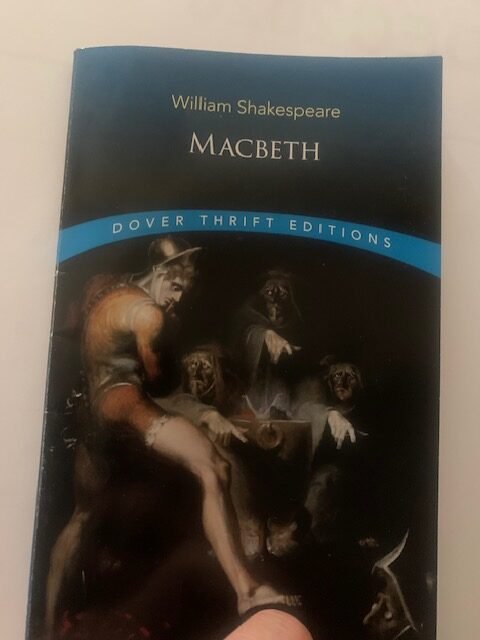
We are doing ‘Macbeth’ this week, a classic Shakespeare play… I am not in love with Shakespeare. I have read only three works by him in the past three years. We’ll see how it goes in the discussion this weekend. 😧 (Macbeth is not recommended for ESL learners but perhaps your native language? Maybe not. 😜)
A student and I watched our seventh Simpson’s episode together in two years: ‘Homer’s Enemy’, a classic from 1997! Watching the Simpsons is a creative and fun way to learn English AND classic American culture. I watched this episode live back then and I can’t believe it is now 29 years old!
In this famous episode, the Simpson family meets a new friend named John, who owns a cool antique shop. Homer really likes John at first, but then he finds out that John is gay. Suddenly, Homer feels very uncomfortable and starts to act strange around him. Homer becomes worried that John’s friendship with his son, Bart, will change Bart in a bad way, so Homer tries to make Bart do more “manly” activities, like hunting. During a hunting trip, the family meets a dangerous reindeer, and it is actually John who saves them and shows real courage. After this, Homer understands that his fears were silly and wrong, and he learns to accept John for who he is. This episode is well-known because it deals with a serious topic, tolerance, in a funny and thoughtful way.
(Story English) A student is reading the classic novel, ‘One Flew Over The Cuckoo’s Nest.’ Why? Well, he found it for 70% off at a book store so he figured it was his destiny to read it in English! Crazy? Maybe! 😜 Either way, he is in for an amazing read! And: the book and movie have one of my favorite evil characters EVER, Nurse Ratched. She is played by Academy award winner Louise Fletcher.
📚BOOK: Ken Kesey’s 1962 novel One Flew Over the Cuckoo’s Nest tells the story of Randle McMurphy. He is a rebellious man who pretends to be insane to serve a short prison sentence in a mental hospital. Inside, he challenges Nurse Ratched, a strict and controlling woman who rules the ward with fear and strict rules. The story is told by Chief Bromden, a quiet Native American patient. He watches McMurphy bring energy and hope back to the beaten-down patients. Through their battle of wills, the book explores themes of freedom, individuality, and how society tries to control people who do not fit in. (I gave it 5/5 stars!)
🎥🍿MOVIE The 1975 film adaptation, directed by Miloš Forman and starring Jack Nicholson as McMurphy: It became a massive critical and commercial success that brought the story to an even wider global audience. It achieved rare cinematic history. It became only the second film ever to sweep all five major Academy Awards: Best Picture, Best Director (Forman), Best Actor (Nicholson), Best Actress (Louise Fletcher as Nurse Ratched), and Best Adapted Screenplay. With its brilliant performances and memorable soundtrack, the movie remains one of the most famous and celebrated films in American cinema. (One of my favorite movies EVER.)
WATCH CLOSELY. Watch the legendary Nurse Ratched:
Nurse Ratched: “Your hand is staining my window.”
Nurse Ratched: “If Mr. MacMurphy doesn’t want to take his medication orally, I am sure we can arrange so he can have it some OTHER way.”
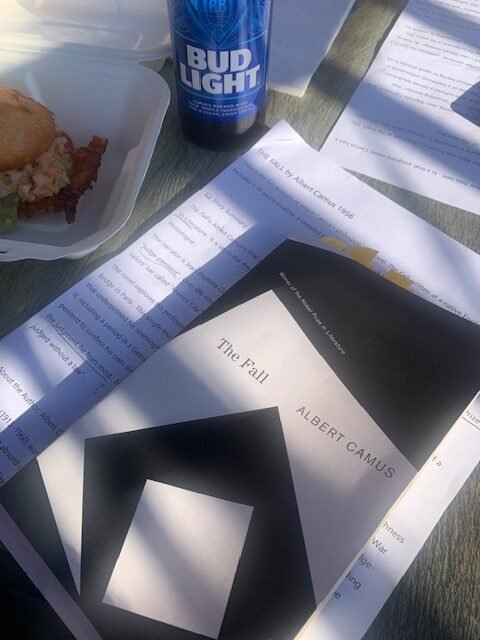
Our last discussion was, ‘The Fall’ by Nobel Prize winner Albert Camus. It is a crazy, fun and at times disturbing look into Camus mind. Some even say it is a kind of confession about his own life. 5/5 Stars. ⭐⭐⭐⭐⭐
The Fall is a small (120 ish pages) philosophical novel published in 1956. It is told as a long, one-sided conversation. The narrator is a former successful lawyer from Paris named Jean-Baptiste Clamence, who now lives in Amsterdam. Over several days, he confesses his life story to an unnamed listener in a sailors’ bar. Through his confession, he explores his own hypocrisy, guilt, and human judgment. The novel is a deep, sometimes dark reflection on morality, innocence, and the difficulty of living an honest life in a world without easy answers.
(Story English) A student just finished seasons one and two of, ‘The Handmaid’s Tale’. I personally loved the book and give it 5/5 stars and season 1 as well. The series is rated 8.3/10 on IMDB and can be seen on Hulu, Prime video and Netflix where available.
📺 THE HANDMAID’S TALE – NO SPOILERS
Short Summary
Author: Margaret Atwood (novel, 1985)
Creator of TV Series: Bruce Miller
Director of First Episodes: Reed Morano
What Is It About?
The Handmaid’s Tale is set in a future world called Gilead. Gilead used to be the United States, but a religious group took control. They created a strict, cruel society.
In Gilead, women have no rights. They cannot read, write, or have their own money. Fertile women are forced to become Handmaids. Their only job is to have children for rich, powerful men and their wives.
The story follows a Handmaid named Offred. She tries to survive in this dangerous world while remembering her old life. The series explores themes of control, resistance, identity, and hope.
Most people watch movies in English and wonder why their English isn’t improving. The problem isn’t the movie. It’s the method.
Here’s how to actually learn from movies in English — the Pete’s Lab way.
Step 1 — Choose the right movie Don’t start with Shakespeare or fast-talking action films. Choose something you already know well in your own language. Familiar stories remove the pressure of following the plot — so you can focus on the language.
Step 2 — Watch without subtitles first Just watch. Don’t stop. Don’t look things up. Get comfortable with not understanding everything. This is normal. This is learning.
Step 3 — Watch again with English subtitles Now watch the same scene again with English subtitles. Notice the gap between what you heard and what was actually said. That gap is where your learning happens.
Step 4 — Stop and discuss This is where Pete’s Lab comes in. Pause the movie. Talk about what happened. What did the character mean? Why did they say it that way? What vocabulary did you notice?
Step 5 — Use the dialogue Try repeating the lines. Act them out. This is exactly what Pete’s Drama English does — and it works because your brain connects language to emotion and story.
The result: Students who learn English through movies develop natural, confident speech — because they’ve heard real English used in real situations by real people.

 STORY ENGLISH: MOVIES, SERIES AND MORE!