Reading great literature is one of the best ways to learn English. But it is more than that. Short stories teach you about human behavior, history, psychology, and life. Every lesson with Pete goes deeper than language.
‘Story English’ also includes learning English through the discussion of movies, series, documentaries, webtoons and just about any type of story form you choose.
One of the best ways for you to get speaking time in class is to just tell a story: A story from your day or your week from your job or your homelife.
Pete has curated over 50 classic short stories for English learners. Here is how a Story English lesson works.
Step 01
Before Class
You listen to the story and explore the supporting materials. Each story comes with free audio, supporting links, author information, and a full study guide prepared by Pete.
Step 02
During Class
You and Pete discuss the story for about 30 minutes. You analyze the characters, the themes, and what the author is really saying. The discussion is where the real learning happens.
Step 03
After Class
You keep the study guide. Re-read the story, explore the links, or join Pete’s Books & Movies WhatsApp group to keep the conversation going with other students.
Four levels of reading
You choose your level. You choose how deep you want to go.
Level 1 — Beginner
Read & Understand
Read the story and understand the basic idea. What happens? Who are the characters?
Level 2 — Intermediate
Read More Carefully
Read more carefully. Notice the characters’ names, the symbols, and the themes. What is the story really about?
Level 3 — Advanced
Go Deeper
Discuss the story with Pete. Explore characters, themes, and symbols—and maybe discover something about yourself.
Level 4 — Masterclass
Go All the Way
Longer discussions, deeper research into the author, plus supporting materials, quizzes, and richer insights.
“Remember: in a great short story, what is NOT said is often the most important thing.”
Who is this for?
You do not need to
love reading already.
This is a special program for Level B1 to C2 and native level English speakers! Many of Pete’s students discover a love of literature for the first time.
If the story is difficult, there are videos and supporting materials to help you understand. You choose your level. You choose how deep you want to go.
What will you learn?
Six things that will change how you use English
How to read and understand classic English literature
New vocabulary in context — not from a textbook
How to discuss complex ideas in English
Human behavior & psychology through storytelling
How to analyze themes, symbols, and characters
How to form & express your own opinions in English
Ready to start?
Ready to read the classics
and speak better English?
Pick a story. Read it before class. Then talk about it with Pete for 30 minutes. That’s it.
Story English is not just about books and short stories.
A story can be anything:
A classic short story or novel
A movie or film
A TV series, Netflix Series or documentary
A webtoon or graphic novel
A podcast or true crime story
Whatever YOU want to talk about
How it works with movies and series:
Just like with audio short stories — we discuss, we analyze. What happened? Why did the character do that? What does this scene tell us about human nature? What vocabulary did you notice?
The best conversations happen when the story matters to YOU. Bring Pete your favorite movie, series or show — and we’ll turn it into an English lesson.
Join the Conversation
Pete's Community
Pete has a WhatsApp community group called Pete’s Books / Movies / Series / Music a place to share songs, discover new music, and practice English through the music you love.
Access to this group is available to Pete’s students.
Today, we did a quote from a favorite scene of mine from Gladiator. Emperor Commodus is entering Rome for the first time as Emperor. After riding into the city to the cheers of the crowd, he meets Senator Falco on the steps:
FALCO: “Rome greets her new emperor. Your loyal subjects bid you welcome, your highness.”
COMMODUS: “Thank you Falco. And for the loyal subjects. I trust they weren’t too expensive.”
The scene is brilliant for its visual effects and emotion. But it also captures the dark, corrupt side of Rome. You can catch the exact quotes at 1:46:
A student recently got hooked on the Netflix series, ‘The Tudors.’ Watching series in English or with subtitles is a fun way to learn some English. Discussing it in class is a great way to practice and internalize the language!
The Tudors is a historical drama series on Netflix that tells the story of King Henry VIII of England. It follows his long and dramatic reign, focusing on his six marriages and his constant search for a male heir. The show is full of political intrigue, passion, and betrayal as Henry breaks from the Catholic Church to marry Anne Boleyn and changes the course of English history. It is a lavish and sexy look at the royal court, full of power struggles and famous historical figures.
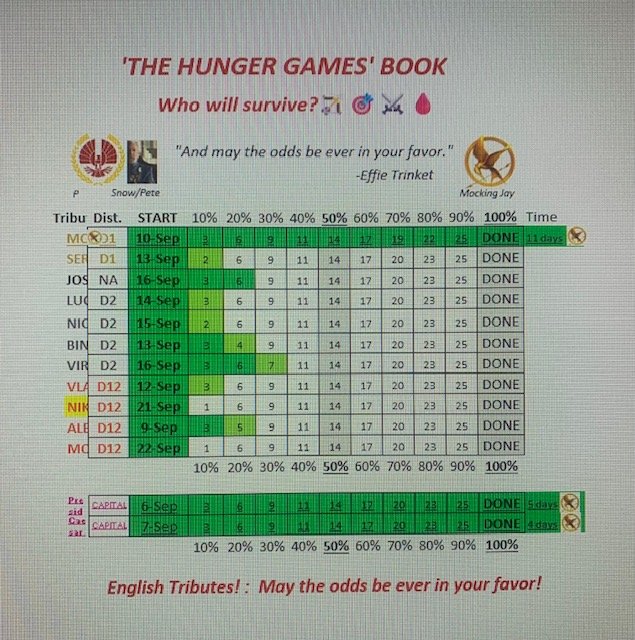
Well, the Hunger Games Book Challenge continues — and yesterday, we had our first finisher! She managed to complete the book in just eleven days. (She is level B2/C1.) Since most students started the book at different times, we don’t know yet who will finish the quickest overall, but eleven days will be hard to beat! 🔥
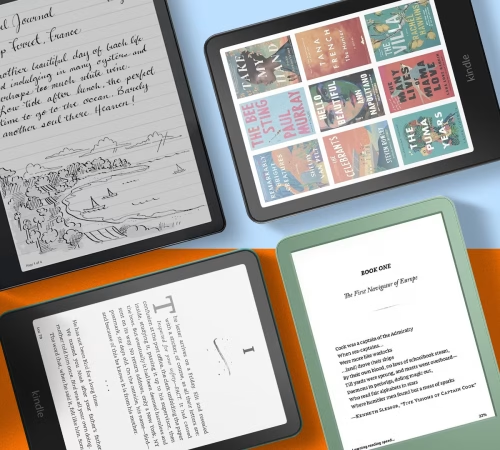
What was the secret to her success? First, of course, was her interest and drive. She really enjoyed the suspense and loved the novel — and that made a big difference. But she also had a kind of secret weapon: she used an e-book and an audiobook together. She followed along on a tablet while playing the audiobook from Apple Books on her phone, reading the screen as the audio played. Not a bad idea. 🎧📱
Now, whether this technique is for everyone, or even the best idea, I honestly don’t know. What I do know is that every student reads differently. Some prefer paper books, some like e-books, and some love audio — and that’s fine. Which method is “best,” or which combination works better, isn’t really the point. In ESL, what matters most is whatever gets you to actually finish the book — and whatever helps you enjoy and understand the material at your own pace. 🙌
So grab a book in your favorite format (or formats!), find a quiet spot, and enjoy the story. 📖✨
We still have ten more students left in the Hunger Games Book Challenge, and it’ll be interesting to see how the rest go. Will it be e-books, paper books, audio, or some combination? Time will tell. ⏳🔥
Part of this month’s game in the Whatsapp group: Recite President Snow’s welcome to the Hunger Games!
Give it a try!: Be sure to speak loudly, like you are presenting to a crowd. Also don’t forget your pauses “…” for effect and drama! AND: May the odds be ever in YOUR favor! :
President Snow:
“Welcome…! Welcome…! Tributes, we welcome you. We salute your courage and your sacrifice… and we wish you… Happy Hunger Games! And may the odds be ever in your favor.”
‘The Hunger Games’ can help you sleep, believe it or not! 🛌
Right now, 10 of my students are reading The Hunger Games — some of them right before bed! And this made me think about something important: what we do before sleep really changes how well we sleep. 🌙
When you read a book before bed, your brain relaxes. The light from a book is soft, and your mind slowly gets tired as you follow the story. Reading The Hunger Games at night is actually a great choice — it’s exciting, but it doesn’t give you the same “shock” to your brain that a phone does. You finish a chapter, feel sleepy, and drift off naturally. 💤
Now compare that to watching YouTube, scrolling through social media, or “doom scrolling” (when you keep scrolling and scrolling, even when it makes you feel bad or anxious). Phone screens send out blue light, and blue light tells your brain, “Wake up! It’s still daytime!” This makes it harder to fall asleep. Also, social media often shows us fast, exciting, or stressful content, so instead of calming your mind, it keeps your brain active and alert. 📱⚡
Doom scrolling is especially bad. You tell yourself, “just five more minutes,” but suddenly an hour has passed, and your brain is full of information instead of ready for rest. 😩
So here’s my advice, especially for my Hunger Games readers: put the phone away, pick up the book, and read a chapter or two before bed. Your brain — and your sleep — will thank you. 😊
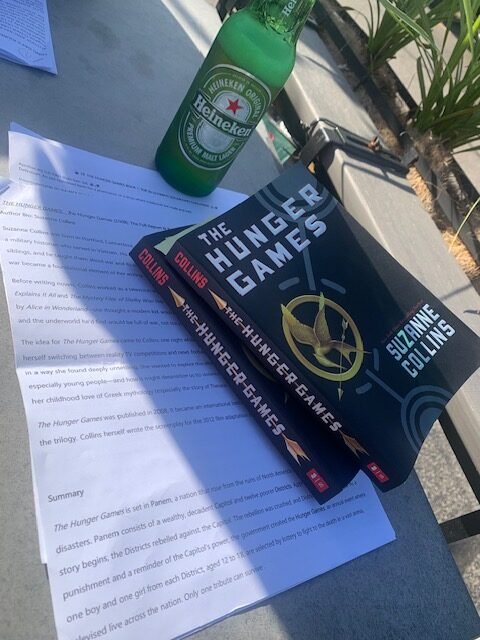
Had another discussion at the bar for ‘The Hunger Games’ this weekend. It was a good time AND: of course, my rating of 5/5 Stars still stands! Typically, the more I talk about a book, the more I like it. The Hunger Games is no exception. I am looking forward to further discussion with my ten student readers! 🧐🥳🧠 No BEER in class of course!

 STORY ENGLISH: MOVIES, SERIES AND MORE!