Reading great literature is one of the best ways to learn English. But it is more than that. Short stories teach you about human behavior, history, psychology, and life. Every lesson with Pete goes deeper than language.
‘Story English’ also includes learning English through the discussion of movies, series, documentaries, webtoons and just about any type of story form you choose.
One of the best ways for you to get speaking time in class is to just tell a story: A story from your day or your week from your job or your homelife.
Pete has curated over 50 classic short stories for English learners. Here is how a Story English lesson works.
Step 01
Before Class
You listen to the story and explore the supporting materials. Each story comes with free audio, supporting links, author information, and a full study guide prepared by Pete.
Step 02
During Class
You and Pete discuss the story for about 30 minutes. You analyze the characters, the themes, and what the author is really saying. The discussion is where the real learning happens.
Step 03
After Class
You keep the study guide. Re-read the story, explore the links, or join Pete’s Books & Movies WhatsApp group to keep the conversation going with other students.
Four levels of reading
You choose your level. You choose how deep you want to go.
Level 1 — Beginner
Read & Understand
Read the story and understand the basic idea. What happens? Who are the characters?
Level 2 — Intermediate
Read More Carefully
Read more carefully. Notice the characters’ names, the symbols, and the themes. What is the story really about?
Level 3 — Advanced
Go Deeper
Discuss the story with Pete. Explore characters, themes, and symbols—and maybe discover something about yourself.
Level 4 — Masterclass
Go All the Way
Longer discussions, deeper research into the author, plus supporting materials, quizzes, and richer insights.
“Remember: in a great short story, what is NOT said is often the most important thing.”
Who is this for?
You do not need to
love reading already.
This is a special program for Level B1 to C2 and native level English speakers! Many of Pete’s students discover a love of literature for the first time.
If the story is difficult, there are videos and supporting materials to help you understand. You choose your level. You choose how deep you want to go.
What will you learn?
Six things that will change how you use English
How to read and understand classic English literature
New vocabulary in context — not from a textbook
How to discuss complex ideas in English
Human behavior & psychology through storytelling
How to analyze themes, symbols, and characters
How to form & express your own opinions in English
Ready to start?
Ready to read the classics
and speak better English?
Pick a story. Read it before class. Then talk about it with Pete for 30 minutes. That’s it.
Story English is not just about books and short stories.
A story can be anything:
A classic short story or novel
A movie or film
A TV series, Netflix Series or documentary
A webtoon or graphic novel
A podcast or true crime story
Whatever YOU want to talk about
How it works with movies and series:
Just like with audio short stories — we discuss, we analyze. What happened? Why did the character do that? What does this scene tell us about human nature? What vocabulary did you notice?
The best conversations happen when the story matters to YOU. Bring Pete your favorite movie, series or show — and we’ll turn it into an English lesson.
Join the Conversation
Pete's Community
Pete has a WhatsApp community group called Pete’s Books / Movies / Series / Music a place to share songs, discover new music, and practice English through the music you love.
Access to this group is available to Pete’s students.
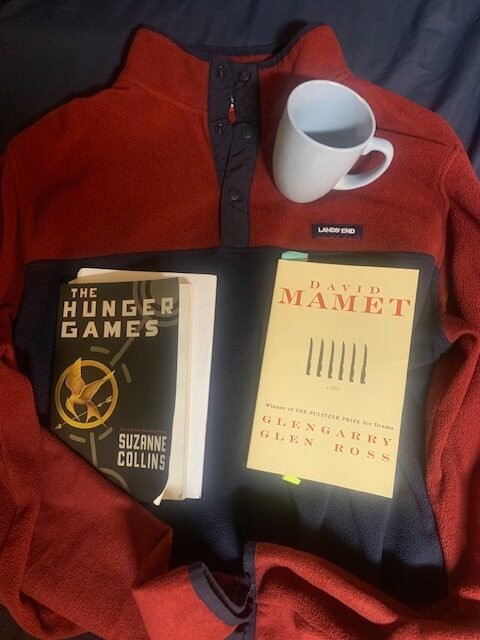
🍂IT’S READING SEASON! It’s getting to be that time of year! The weather is getting cooler and more crisp. Autumn/Fall is on its way! So, find a comfortable chair and maybe a nice fireplace. Grab your favorite ‘comfort clothing’ (a pullover?) ‘comfort drink’ (Latte or a Coffee?) and a favorite book, The HUNGER GAMES? 🏹😉
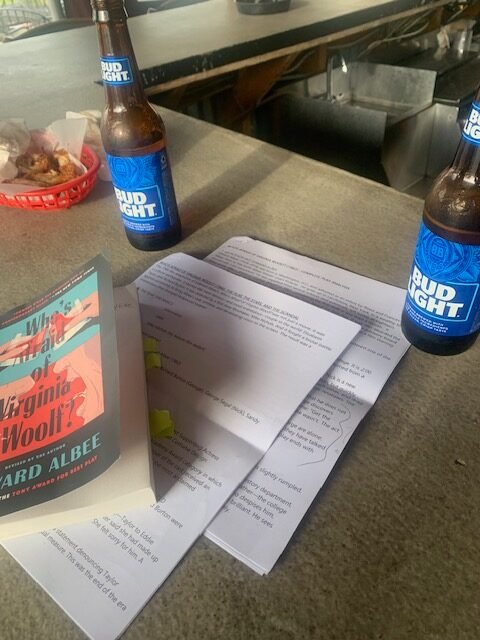
Okay, so this week’s story started as a play. Edward Albee wrote it in 1962. It was a big deal on Broadway in the USA. Shocking. Raw. People didn’t know what to do with it. Then in 1966, they made it into a movie. Same story. Same brutality. But now you could see their faces up close. 🎭🎬
The story is simple. George and Martha are married. They hate each other. They love each other. It’s messy. They come home from a party at 2 AM and invite a young couple over. Nick and Honey. They have no idea what they’re walking into.
The whole night is one long fight. Screaming. Insults. Mind games. Drinking. Lots of drinking. It’s brutal. It’s funny too in between all the crazy bullshit. It’s uncomfortable. You can’t look away.
Elizabeth Taylor and Richard Burton were married in real life. And their real marriage was rumored to be almost or just as crazy. So when they fight on screen, it doesn’t feel like acting. It feels real. Taylor gained weight and made herself look old. She destroyed her glamorous image. Burton is quiet and scary. He waits. He strikes. They’re both incredible.
The movie is about a lot of things. Lies. Games. The fear of being empty. George and Martha have a secret. An imaginary son. By the end of the night, George kills him. It’s the most loving thing he’s ever done. And the most cruel.
It’s not a happy movie. It’s kinda not a sad movie in some ways. It’s just… honest. And that’s what makes it a masterpiece. 🎬💔 Hard to watch but totally crazy and totally worth the watch!
A student and I are watching and analyzing the English and cultural references in, ‘Treehouse of Horror VII’!
It’s almost October and Halloween is just around the corner in the USA! A student and I are watching a famous Simpson’s episode. Halloween season means one thing in the Simpsons universe: it’s time for “Treehouse of Horror”! (Simpsons Halloween episodes are called, ‘Treehouse of Horror) And Episode 7 (from 1996) is one of the wildest, weirdest entries in the whole series. 👽 It is a personal favorite!
The episode kicks off with a hilarious framing device — Bart and Lisa are fighting over who gets to open the treehouse door and start the show, so we actually get TWO competing openings before the real fun begins! 😂🚪
Then comes three spooky, silly segments: 🍬
🐣 “The Thing and I” — Homer and Marge have a secret: Bart has an evil twin hidden in the attic! It’s part creepy, part hilarious family chaos. 🏚️
🌍 “The Genesis Tub” — Lisa accidentally creates an entire tiny civilization in a soda bottle using tooth decay and static electricity (classic Simpsons science! 🧪✨). The tiny people even build a Lisa-worshipping society — until Bart gets involved and things go hilariously wrong. 👑🔬
🗳️ “Citizen Kang” — Probably the most famous segment of the whole franchise! Aliens Kang and Kodos kidnap and impersonate the two U.S. presidential candidates, running for office in disguise. It’s a sharp, funny jab at politics that still gets quoted every election season. 👽🎤🇺🇸
This episode is peak Halloween Simpsons: weird, funny, a little dark, and packed with quotable moments. Perfect spooky season binge material! 🍂🦴🧡 Check it out for laughs and uh, yeah: for learning some ENGLISH!
A reading and racing comparison: ‘Ford Vs. Ferrari’ 2019 🎬
How fast should you go when reading something? THAT is a good question. The answer is, you should read as fast as you can while still understanding what you are reading. So, how do you know exactly how fast is best for YOU? 🤔
Let’s take a look at a clip from the 2019 movie, ‘Ford Vs. Ferrari.’ 🏁 In this clip, racer Ken Miles is teaching his son Peter how to drive a ‘perfect lap’. That means going fast. But! : Ken explains that you don’t want to go SO fast that you wear the car out, blow the engine or fly off the track! 💥 You want to drive ‘perfectly,’ but also, “You have to be kind to the car.” ❤️🏎️
Now let’s take a closer look at the racing in Ford Vs Ferrari scene. Let’s do the analogy:
The CAR🏎️ = YOUR brain. 🧠
The race track🛣️ = the book you are reading. 📖
One time around the race track 🔄 = one chapter in your book.
So, let’s say you are reading a book with 27 chapters like, ‘The Hunger Games’. 🏹 That means your brain (race car🏎️) has to get around the race track (book) 27 times! 🔁 That means: -You have to drive around the track/chapter fast, but not so fast that you fly off the track (lose your understanding). 🚧 -You have to drive around the track/chapter fast, but don’t blow your engine/brain by working too hard and getting too tired. Then you lose motivation and don’t finish. You burn out and blow your engine! 🤯🧠🔧
So what’s the finish line here? 🏁 It’s not about setting a lap record on chapter one and collapsing by chapter five. It’s about finding YOUR perfect racing speed — fast enough to stay engaged and make progress, slow enough that your engine (brain 🧠) is understanding, and still running strong 27 laps later. Some readers are built for speed. Some need a steadier pace to keep control on every turn. Both can cross the finish line. 🏆
Like Ken told his son: you have to be kind to the car. Be kind to your brain, too. Find your pace, trust it, and drive all the way to the last page. 🏎️📚💨
“You have to be kind to the car. (🏎️😉🧠) If you’re going to push a piece of machinery to the limit, and expect it to hold together, you have to have some sense of where that limit is.” — Ken Miles (Ford Vs Ferrari)
THEN: Once you know YOUR correct speed that allows YOU to UNDERSTAND what you are reading and won’t make you burn out, you do THIS!:
The Hunger Games is rated B2 on the CEFR scale. This means it is suitable for upper-intermediate English learners. Here is why.
1. 📚 VOCABULARY
The book uses everyday language for most of the story. Words like “hunger,” “survive,” “district,” and “tribute” are repeated often, which helps learners remember them.
However, the book also uses some difficult words that are not common in daily conversation:
tesserae – extra food for extra name entries
cornucopia – a giant golden horn
muttation – a genetically altered animal
sustenance – food and nourishment
apothecary – a person who makes medicine
These words appear often enough that learners can understand them from context, but they still need a dictionary sometimes. This mix of easy and difficult words is typical of B2.
2. 📝 SENTENCE STRUCTURE
Most sentences are short and direct. Suzanne Collins writes in a clear, fast style. For example:
“I volunteer!” I gasp. “I volunteer as tribute!”
This is easy to understand. But sometimes the sentences become longer and more complex, especially when Katniss describes her feelings or memories:
“The moment I hear Prim’s name, everything inside me freezes. The world stops. I cannot move. I cannot breathe. Then something breaks inside me, and I am running, pushing through the crowd, shouting her name.”
These longer sentences require B2-level reading skills.
3. 🧠 THEMES AND IDEAS
The book deals with serious and complex themes:
Poverty and inequality – the Districts starve while the Capitol is rich
Violence and death – children killing children
Rebellion and resistance – the mockingjay, the three-finger salute
Performance and image – Katniss must pretend to be in love to survive
Trust and betrayal – can Katniss trust Peeta?
These themes require critical thinking and emotional maturity. A B1 reader might understand the plot but miss the deeper meanings. A B2 reader can understand both the story and the ideas behind it.
4. 📖 LENGTH AND PACE
The book is 374 pages long. It has 27 chapters and is divided into three parts. The plot moves quickly, with short chapters and cliffhangers at the end of many chapters. This keeps readers motivated.
But the length means learners must have stamina to finish. A B1 reader might get tired. A B2 reader can handle longer texts.
5. 🎭 NARRATIVE STYLE
The book is told in first person by Katniss. This means the reader sees everything through her eyes. Her voice is direct, honest, and emotional. She does not explain everything—she assumes the reader understands.
For example, she says:
“I take tesserae. It’s not something I’m proud of.”
She does not explain what tesserae is. She assumes you understand from context. This is a B2 skill: reading between the lines.
6. 🌍 CULTURAL REFERENCES
The book includes references to:
Ancient Rome – the Capitol, the Games, “Panem et Circenses”
Reality television – the Games are filmed and watched
Greek mythology – the story of Theseus and the Minotaur
These references add depth. A B1 reader might miss them. A B2 reader can recognize and understand them.
7. ✍️ WHY NOT B1?
The book is not B1 because:
The vocabulary is too rich
The themes are too complex
The sentences are sometimes too long
The cultural references are too specific
The emotional depth requires maturity
A B1 reader could read the book with help (a dictionary, a teacher, a study guide). But a B2 reader can read it independently and understand most of it.
8. ✍️ WHY NOT C1?
The book is not C1 because:
The language is mostly conversational, not academic
The vocabulary is not highly specialized
The sentences are not extremely complex
The ideas are accessible to most adult readers
C1 books are usually literary fiction or academic texts with dense language and abstract ideas. The Hunger Games is popular fiction—it is designed to be read quickly and enjoyed.
📊 SUMMARY TABLE
Feature
Why It Is B2
Vocabulary
Mix of easy words and some difficult words
Sentences
Mostly short, sometimes long and complex
Themes
Serious and complex (poverty, violence, rebellion)
Length
374 pages—requires stamina
Narrative
First person, assumes reader understands context
References
Roman history, Greek myth, reality TV
Why Not B1
Too rich, too deep, too long for B1
Why Not C1
Too conversational, too accessible for C1
🎯 CONCLUSION
The Hunger Games is B2 because it challenges learners without overwhelming them. It uses everyday language but also introduces new words. It tells a fast, exciting story but also explores serious ideas. It is the perfect book for a learner who is ready to move from simple stories to real literature.
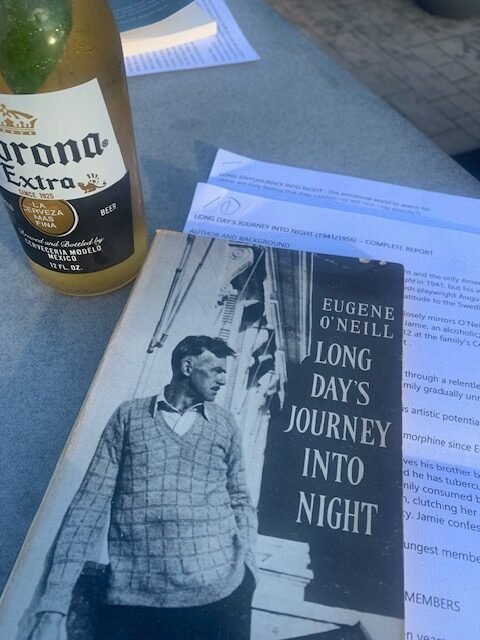
We read and watched an old school play this week, ‘A Long Days Journey Into Night. I absolutely loved it! It is extremely rare for me, but I knew this one was a 5/5 star when I was only half finished! It is an amazing one day journey into human relationships, behavior and emotions. And, when you throw substance addictions in there, its fascinating to consider the influences on the four family members.
The very latest version of the story opened up on September 25, 2026 and stars Jessica Lange and Ed Harris! (See Trailer below.)
Long Day’s Journey into Night is a play by Eugene O’Neill. It was written in 1941 but published in 1956. It is set in a summer home in Connecticut USA in August 1912. The play follows one long, painful day with the Tyrone family. James, the father, is a famous but stingy actor who gave up his artistic dreams for money. Mary, the mother, is addicted to morphine and cannot face the truth about her son’s illness. Jamie, the older son, is a cynical alcoholic who loves his brother but also wants to hurt him. And finally there is Edmund, the younger son. He is sick with tuberculosis and is the most sensitive member of the family.
Over the course of this single day, the family argues, confesses secrets, and reveals how much they love and hate each other, showing how the past never really goes away. The play is famous for being honest, sad, and autobiographical—O’Neill based it on his own family and did not allow it to be published until 25 years after his death.
🎭 Long Day’s Journey Into Night — Very Brief Facts
Writer: Eugene O’Neill
Written: 1941–42; published after his death in 1956.
Setting: Connecticut, during one day in August 1912.
Story: The Tyrone family struggles with addiction, illness, alcoholism, regret and family conflict.
Autobiographical: The family is closely based on O’Neill’s own family.
Award: Pulitzer Prize for Drama.
🎬 NEW FILM — JUST OPENED
U.S. opening: September 25, 2026 — limited theatrical release.
Jessica Lange: Mary Tyrone
Ed Harris: James Tyrone
Ben Foster: Jamie
Colin Morgan: Edmund
Director: Jonathan Kent
Lange previously won a Tony Award for playing Mary on Broadway in 2016.
Where to see it now: Select U.S. movie theaters. In Los Angeles, it is currently playing at the Lumiere Cinema.
Streaming: No U.S. streaming release has been announced yet.
There are SO many versions of this amazing play over the decades. My favorite is the Katharine Hepburn movie, 1962.

 STORY ENGLISH: MOVIES, SERIES AND MORE!