Today, we did a quote from a favorite scene of mine from Gladiator. Emperor Commodus is entering Rome for the first time as Emperor. After riding into the city to the cheers of the crowd, he meets Senator Falco on the steps:
FALCO: “Rome greets her new emperor. Your loyal subjects bid you welcome, your highness.”
COMMODUS: “Thank you Falco. And for the loyal subjects. I trust they weren’t too expensive.”
The scene is brilliant for its visual effects and emotion. But it also captures the dark, corrupt side of Rome. You can catch the exact quotes at 1:46:
A student recently got hooked on the Netflix series, ‘The Tudors.’ Watching series in English or with subtitles is a fun way to learn some English. Discussing it in class is a great way to practice and internalize the language!
The Tudors is a historical drama series on Netflix that tells the story of King Henry VIII of England. It follows his long and dramatic reign, focusing on his six marriages and his constant search for a male heir. The show is full of political intrigue, passion, and betrayal as Henry breaks from the Catholic Church to marry Anne Boleyn and changes the course of English history. It is a lavish and sexy look at the royal court, full of power struggles and famous historical figures.
Below is a new activity I recently created. Using passwords for pronunciation practice. The long password below is quite a challenge. Try it. Use the ‘Name’ and ‘Pronunciation Tip’ columns for help. Do you think someone could understand you as pronounced all these symbols over a phone or in person??? 😉
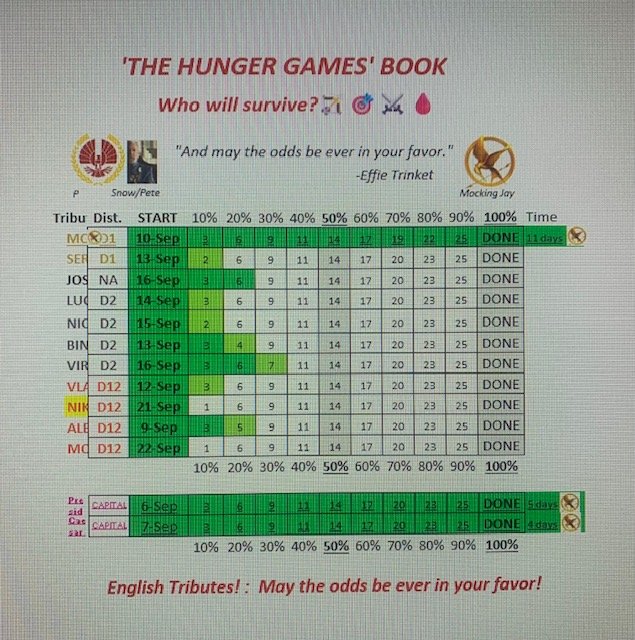
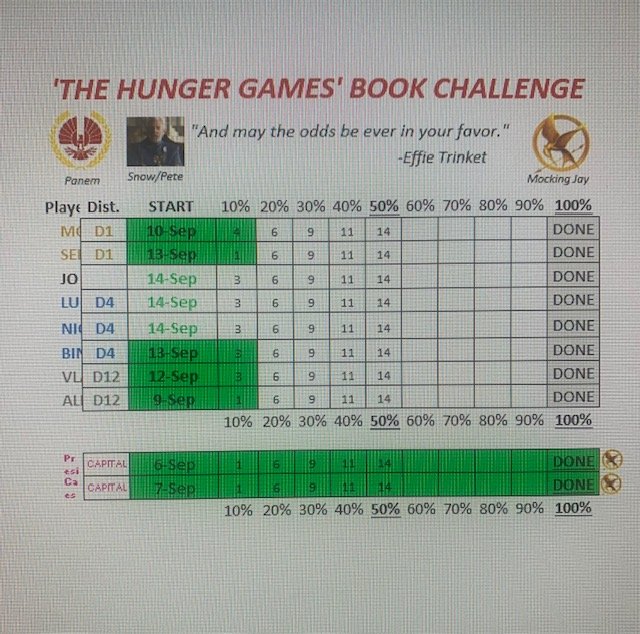
Well, the Hunger Games Book Challenge continues — and yesterday, we had our first finisher! She managed to complete the book in just eleven days. (She is level B2/C1.) Since most students started the book at different times, we don’t know yet who will finish the quickest overall, but eleven days will be hard to beat! 🔥
What was the secret to her success? First, of course, was her interest and drive. She really enjoyed the suspense and loved the novel — and that made a big difference. But she also had a kind of secret weapon: she used an e-book and an audiobook together. She followed along on a tablet while playing the audiobook from Apple Books on her phone, reading the screen as the audio played. Not a bad idea. 🎧📱
Now, whether this technique is for everyone, or even the best idea, I honestly don’t know. What I do know is that every student reads differently. Some prefer paper books, some like e-books, and some love audio — and that’s fine. Which method is “best,” or which combination works better, isn’t really the point. In ESL, what matters most is whatever gets you to actually finish the book — and whatever helps you enjoy and understand the material at your own pace. 🙌
So grab a book in your favorite format (or formats!), find a quiet spot, and enjoy the story. 📖✨
We still have ten more students left in the Hunger Games Book Challenge, and it’ll be interesting to see how the rest go. Will it be e-books, paper books, audio, or some combination? Time will tell. ⏳🔥
Part of this month’s game in the Whatsapp group: Recite President Snow’s welcome to the Hunger Games!
Give it a try!: Be sure to speak loudly, like you are presenting to a crowd. Also don’t forget your pauses “…” for effect and drama! AND: May the odds be ever in YOUR favor! :
President Snow:
“Welcome…! Welcome…! Tributes, we welcome you. We salute your courage and your sacrifice… and we wish you… Happy Hunger Games! And may the odds be ever in your favor.”
Sometimes the best lesson plan isn’t a traditional lesson plan at all — it’s baseball. ⚾
One of my students recently moved to Los Angeles from Japan, and like a lot of newcomers, he’s still finding his footing in a new city, a new culture, and a new language. But he found something that made the transition feel a little more like home: the Dodgers. 💙🤍
With stars like Ohtani, Yamamoto, and Sasaki on the roster, watching the Dodgers isn’t just entertainment for him — it’s a connection to Japan, right in the middle of his new American life. So we made it part of our classes. Every session, we split our time: half business English, half Dodgers talk. 🗣️📊
And it works beautifully, because it’s not just fun — it’s functional. My student regularly brings clients to Dodgers games as part of his job, and baseball chat is a big part of those business relationships. So we practice real dialogues: how to talk stats at a game, how to make small talk in the stands, how to discuss a player’s big night at work the next morning. 🏟️💼
It’s a perfect example of what good language learning should look like — English that fits into someone’s actual life, not just a textbook. He gets to talk about something he loves, build real vocabulary he’ll use with real clients, and feel a little more connected to his new city, one game at a time. 🌆⚾
‘The Hunger Games’ can help you sleep, believe it or not! 🛌
Right now, 10 of my students are reading The Hunger Games — some of them right before bed! And this made me think about something important: what we do before sleep really changes how well we sleep. 🌙
When you read a book before bed, your brain relaxes. The light from a book is soft, and your mind slowly gets tired as you follow the story. Reading The Hunger Games at night is actually a great choice — it’s exciting, but it doesn’t give you the same “shock” to your brain that a phone does. You finish a chapter, feel sleepy, and drift off naturally. 💤
Now compare that to watching YouTube, scrolling through social media, or “doom scrolling” (when you keep scrolling and scrolling, even when it makes you feel bad or anxious). Phone screens send out blue light, and blue light tells your brain, “Wake up! It’s still daytime!” This makes it harder to fall asleep. Also, social media often shows us fast, exciting, or stressful content, so instead of calming your mind, it keeps your brain active and alert. 📱⚡
Doom scrolling is especially bad. You tell yourself, “just five more minutes,” but suddenly an hour has passed, and your brain is full of information instead of ready for rest. 😩
So here’s my advice, especially for my Hunger Games readers: put the phone away, pick up the book, and read a chapter or two before bed. Your brain — and your sleep — will thank you. 😊
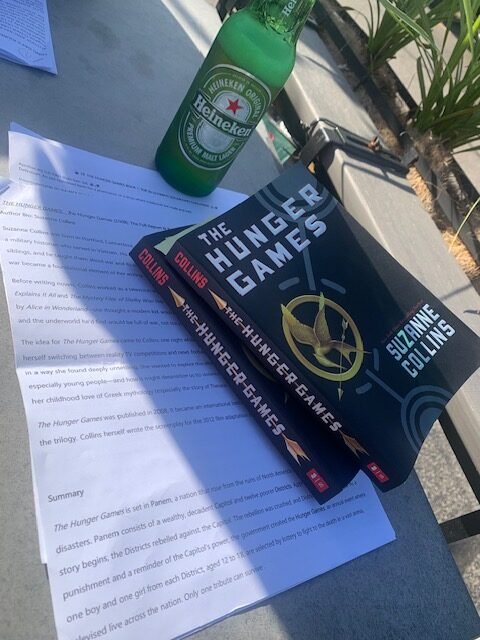
Had another discussion at the bar for ‘The Hunger Games’ this weekend. It was a good time AND: of course, my rating of 5/5 Stars still stands! Typically, the more I talk about a book, the more I like it. The Hunger Games is no exception. I am looking forward to further discussion with my ten student readers! 🧐🥳🧠 No BEER in class of course!
English has one letter combination — “ough” — that can be pronounced at least six different ways. That’s exactly why this list looks scary at first glance: the spelling never tells you how to say it. The only real fix is grouping words by sound, not by spelling, and drilling each small group until it sticks. 🧠
Here’s a version arranged by sound family, so students can see the patterns clearly:
Group 1 — rhymes with “go” (OH sound)
throw = THROH — to send something through the air
though = THOH — however, despite that
although = awl-THOH — despite the fact that; even though
Group 2 — close cousin, but not quite
thorough = THUR-oh — complete and careful
Group 3 — the odd ones out
tough = TUF — hard or difficult
thought = THAWT — an idea in your mind
through = THROO — from one side to the other
This grouping helps because students can lock onto the “go” family first (three words, same sound — easy win), then treat thorough, tough, thought, and through as the trickier exceptions to drill separately. It turns one scary list into small, manageable chunks. 🧠✅
For the first time ever, I did a bit of a church service in class the other day.
I have a student that moved to a new country and town for her job. She went to church and did not understand the English. So, I made a dialogue with AI and we actually read the service together.
She read the part of the priest. I read the part of the people, or congregation and we had a good time. 👼
Moments like this are why I love this job. It is always something new. But also, my student can now walk into church with more ability to follow along, instead of just standing there hoping to keep up. That’s the real goal of language learning. 🙏✨ Another brand new feather in my hat too I guess… 😀
If I had to bet on one question showing up in a job interview, it would still be this one. “Tell me about yourself.” These are simple words, but they still trip up more candidates than almost anything else. That includes plenty of native English speakers, not just ESL learners. Why is it a problem? Because the question feels open-ended, and open-ended questions make people panic. They either ramble for five minutes, or even freeze completely.
Three of my students are practicing answering this question right now in classes. Here’s the good news they have discovered: this question does have a formula. Once you know the formula, it stops being scary. It becomes your favorite question in the whole interview — because it’s the one moment where you control the story. If you do it, right, you are on your way to getting a new job!
Why This Question Matters So Much
Interviewers ask this first for a reason. It’s not small talk. It’s your chance to set the framework for the entire interview. You can help steer the conversation. You can help to decide what they focus on before they start picking things apart themselves. A strong answer builds confidence in the room immediately. A weak, rambling answer does the opposite. It makes the interviewer start the interview already a little worried.
The Classic Method: Past → Present → Future
The best-known structure — and still the most reliable — is essentially a two-minute spoken version of your resume, told as a story with direction. It has three parts:
1. Past — Where you started A brief summary of your background: your education, your early career, the skills you built. Keep this short. This is context, not the main event.
2. Present — Where you are now What you’re currently doing, what you’re good at, and — importantly — a specific achievement or two that proves it. Numbers and results are gold here. “I managed a team of six” is good. “I managed a team of six and increased output by 20%” is much better.
3. Future — Why you’re here, right now, in this interview This is the part people forget, and it’s the most important part. Connect your past and present directly to this company and this role. Explain what drew you to them specifically, and — this is key — pivot toward what you can offer them, not just what you want from them.
The One Rule to Remember
This question is not really “tell me about yourself.” It’s really asking: “Convince me, quickly, that you’re worth the next 30 minutes of my time.” Practice the structure, keep it under two minutes, and always land on how you can help them — not just what you want from them.
The Hunger Games… I had been meaning to read it for years. I just finished it for the first time. I do like a good dystopia. The book was interesting, action packed and the it is well written. But, how good was it?
I have read these other dystopias and enjoyed them. Where does “The Hunger Games” fit on this list of amazing classics??? :
1984 by Orwell, Fahrenheit 451 by Bradbury, We by Zamyatin, Brave New World by Huxley, In Watermelon Sugar by Brautigan, The Man in the High Castle by PK Dick, The Handmaid’s Tale by Atwood, Animal Farm by Orwell, The Trial by Kafka
The answer IS:
The Hunger Games is as good as any of them. ‘The book is a modern classic! Its numbers/readers are so high (10M Ratings on Goodreads) for a reason: It has EVERYTHING: human drama, love, political intrigue, survival, fashion, pageantry, hunting, rich vs poor, evil, stupidity, terror, bla bla bla! YOU name it. 😊
And here’s the thing that puts it right up there with the classics above: most dystopias make you think. The Hunger Games makes you think AND keeps you turning pages.Orwell and Huxley built the blueprint — the surveillance, the propaganda, the control of truth and pleasure — but Collins took that blueprint and handed it to a sixteen-year-old girl with a bow and arrow, and somehow made it feel just as urgent, just as sharp, and fun to read.
So where does it fit on the list? Not as the ‘also ran’ book, tucked at the end out of politeness. Right in the middle, shoulder to shoulder with Orwell and Atwood, earning its spot the honest way — by being genuinely great. A modern classic, no asterisk needed! 🏹🔥
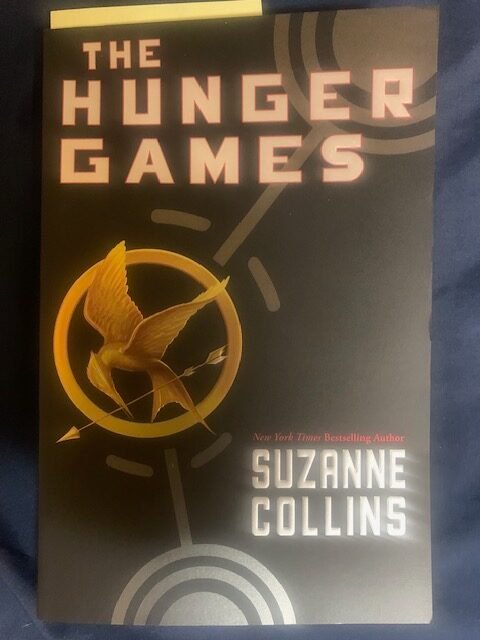
I am happy to report that eight of my students are reading ‘The Hunger Games’ this month. I say ‘this month’ but there is no time limit. Or is there??😉 Perhaps this will turn into a ‘Hunger Games’ kind of competition to finish reading, ‘The Hunger Games.’
I recently finished the book and it is a great read! It is level B2 English and perfect for students. 5/5 stars!⭐⭐⭐⭐⭐ Good luck to all students and MAY THE ODDS BE EVER IN YOUR FAVOR!
It has always been a funny thing to me. Many students think their English teacher should also speak their native language. They say it’s just in case they need help understanding something. This makes sense — but it’s actually a kind of trap. 🪤
Here is the truth: when a student reaches A2 level or higher, sharing a language with the teacher can actually cause problems. Why? Because when translation is easy to get, students use it instead of trying to understand English in English. That difficult moment — when you don’t understand right away — is where real learning happens. 🧠💪 Remember: every minute you spend speaking your native language in class is a minute you are NOT practicing English! ⏳🚫
A good ESL teacher doesn’t need to know your language. They need patience, clear explanations, hand gestures, examples, and the skill to make things simple. These skills work in every classroom, with every student, from every country. 🌍👩🏫So next time you want to ask, “Do you speak my language?” — ask yourself this instead: “Am I ready to stop depending on it?” If your level is already A2 or higher, the answer is almost always yes! ✅🚀
I am proud to say that I have a student working under an O-1 Visa! She started a company here in the USA and she is writing a book about it! (I am now supporting her English fluency journey.👍🏼)
What is an ‘O-1’ VISA?:
The O-1 visa is a nonimmigrant work visa for individuals with extraordinary abilities. It is specifically designed for foreign nationals who have demonstrated exceptional talent in fields such as science, arts, education, business, or athletics, or who have achieved notable recognition in the motion picture or television industry.
Key Features of the O-1 Visa:
Eligibility: Applicants must provide evidence of extraordinary ability, which can include awards, publications, or significant contributions to their field.
Job Offer Requirement: A job offer or recommendation from a U.S. employer is necessary to qualify.
Consultation Process: Before approval, applicants must obtain an advisory opinion from a relevant peer group or organization.
Duration and Extensions: The O-1 visa can be granted for the duration of the event, performance, or activity, with the possibility of unlimited extensions in one-year increments.